
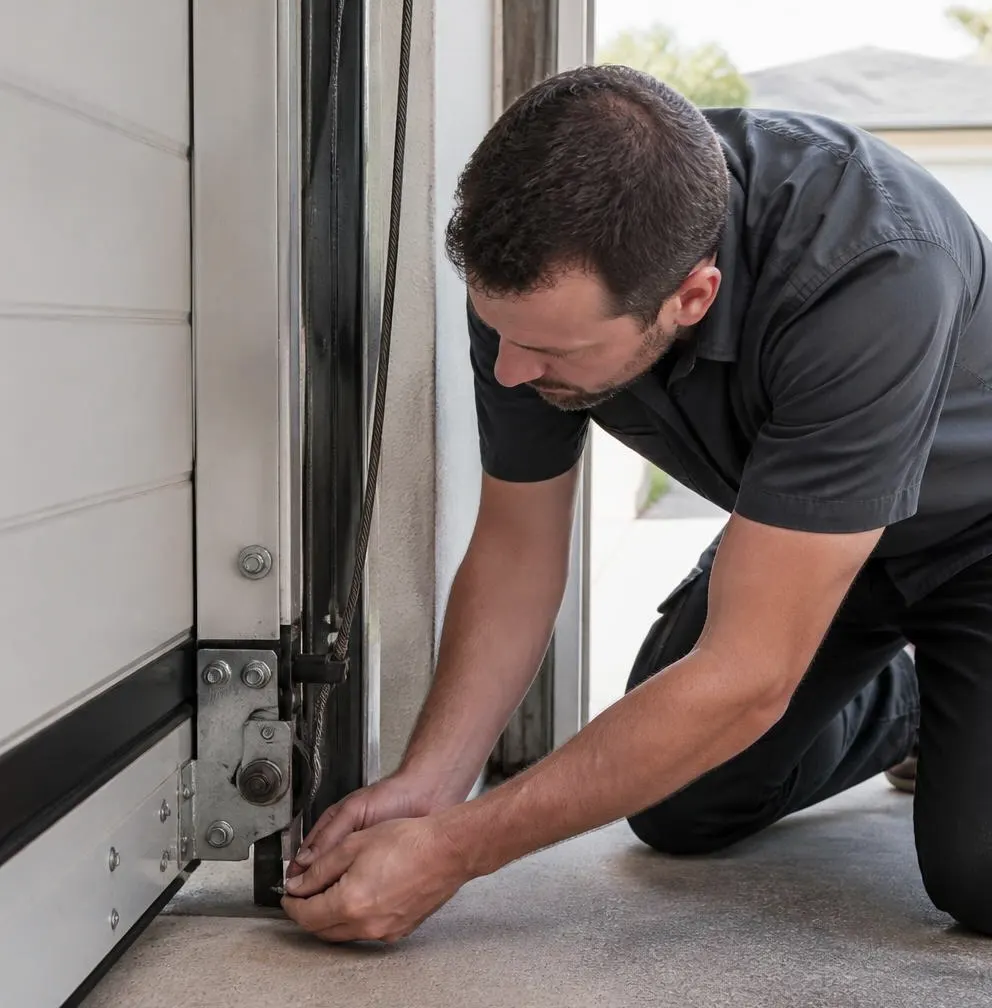
In most cases, a garage door that starts closing and then reverses, or won't close at all, is being stopped on purpose by the safety reversal system. It's reacting to a misaligned sensor, a bad limit setting, or an obstruction rather than suffering a major mechanical breakdown. The fix is usually quick once you know where to look, but a door that reverses because of a weak spring or worn cable needs different handling than one that reverses because of a dirty sensor lens.
What the Symptoms Usually Tell You
- Door reverses the instant it starts closing: almost always a photo-eye sensor problem.
- Door closes partway, then reverses: often an obstruction, track misalignment, or a close-force limit set too sensitive.
- Door won't move at all when you hit close: could be a tripped sensor, a stuck button, or in some cases a spring that's lost tension and the opener's safety logic won't force it.
- Opener light blinks a set number of times after you try to close: many openers use blink codes to point to the sensor circuit — check your owner's manual for the count.
- Problem only happens at certain times of day: low morning or afternoon sun can wash out a sensor's beam, which shows up more here given how much direct glare garage entries get.
Causes, in the Order a Technician Checks Them
1. Safety Sensors (Photo Eyes)
These two small units near the bottom of the track send an invisible beam across the opening. If anything blocks it, or the lenses are dirty or misaligned, the opener assumes something is in the way and reverses. Humidity and salt air common in this area speed up grime buildup and lens fogging, and a stray cobweb or leaf after a windy afternoon storm is enough to break the beam. The fix is cleaning both lenses with a soft cloth and nudging the brackets until the indicator lights on both units go solid rather than flickering.
2. Obstructions in the Door's Path
Before touching anything mechanical, a tech checks the track and threshold for debris, a dropped item, or storm residue that's working its way into the opening. Afternoon downpours this time of year can wash sand, mulch, or small branches right up against the track, and even a small obstruction will trigger a reversal.
3. Track Alignment and Rollers
If the track is bent, pinched, or has shifted, the door will bind partway down and the opener reads that resistance as an obstruction. Humidity swings and wind load on the door during storms can gradually push a track out of true, even without visible damage. A technician checks for gaps between rollers and track, then realigns or replaces sections as needed — this is standard off-track door repair work.
4. Opener Limit and Force Settings
Every opener has a close-limit setting that tells it how far to travel, and a force setting that tells it how much resistance to tolerate before reversing. If these drift out of adjustment — which happens naturally over time, especially with openers exposed to heat and moisture in an uninsulated garage — the door may reverse well before it actually reaches the floor.
5. Spring Tension
A door that's hard to close, or that the opener struggles against, often has a spring that's lost tension or broken. Garage door springs are under serious load and salt air near the coast adds rust that shortens their lifespan faster than it would inland. A weak spring throws off the door's balance enough that the opener's force sensors treat normal closing resistance as an obstruction. This isn't a DIY adjustment — it calls for garage door spring repair with the right tension and gauge for your door's weight.
6. Cables and Rollers
Frayed or slipping cables, and rollers worn from years of swelling and shrinking with humidity, can cause the door to bind or drop unevenly on one side. That uneven movement is often read by the opener as resistance, triggering a reversal partway through the cycle.
7. Opener Logic Board
If sensors are clean and aligned, the track is straight, and springs and cables check out, the issue may be in the opener's circuit board itself. This is the least common cause and the last thing a technician rules out, since replacing a board (or the opener) is a bigger job than the fixes above.
When to Call Titusville Overhead Door Co
If cleaning the sensors and clearing the track don't solve it, or if you notice a cable fraying, a spring that looks stretched or gapped, or the door hanging unevenly, it's time to call. We handle garage door spring repair and off track door repair as routine visits, and we'll check opener force settings and sensor alignment as part of the same trip so the fix actually holds through the next round of storms.
If your door in Titusville, Port St. John, Mims, Cocoa, Rockledge, Merritt Island, Cape Canaveral, or Cocoa Beach is reversing or won't close, call Titusville Overhead Door Co today and we'll get it diagnosed and running safely again.